
 English
Neck pain and headaches: physiotherapy in Zeist
A stiff or painful neck gets in the way all day, and a headache that starts in the neck makes it harder still. For most people it comes from posture, tension and too little variation, rarely from damage. Our physiotherapists in Zeist examine how your neck, shoulders and upper back move. Then you train towards a neck that can handle a working day again.
Written by Jeroen Vermeer, physiotherapist at MoveWell Fysiotherapie Zeist · Last updated 27 October 2026
In short
- A referral is not needed. If you do have one, please bring it.
- You can be seen within a few days.
- The first consultation takes thirty to fifty minutes.
- Exercise therapy for the neck and shoulder blades is the core of the treatment.
- MoveWell has contracts with all Dutch health insurers and invoices them directly.
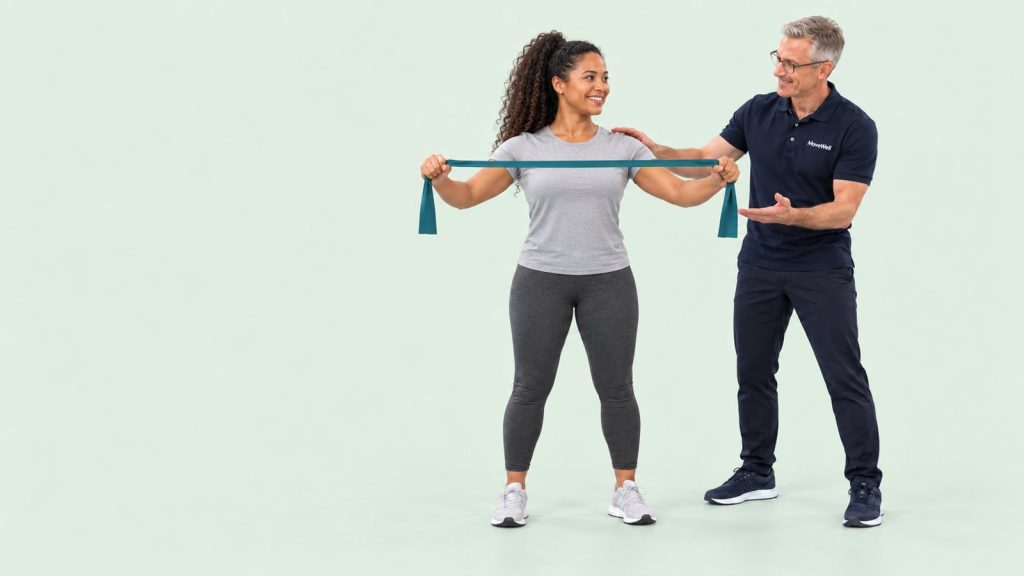
Why does a neck become stiff and painful?
The neck has seven vertebrae. Small muscles deep against the vertebrae steer the head. Large muscles, such as the trapezius, connect the neck to the shoulder blades. Together they carry a head of four to five kilos.
When the head hangs forward over a laptop or phone, the load on the muscles becomes two to three times greater. Neck pain is usually a sum of load, not a sign of damage. That is why the neck responds so well to movement and training.

Can a headache come from the neck?
Yes. A headache is not one complaint, and each type asks for a different approach.
- Tension headache: a tight band on both sides, worse as the day goes on. Physiotherapy helps most here.
- Headache from the neck: starts at the base of the skull, usually on one side, and comes on with long sitting or turning the neck.
- Migraine: throbbing, with nausea. It is a condition of the brain, not of the neck. Physiotherapy does not stop an attack.
How does your physiotherapist examine your neck?
We start with your story: when did it begin, what makes it worse and what do you want to be able to do again. Then your physiotherapist moves your neck in all directions and looks at the upper back and shoulder blades. We measure the strength of the deep neck muscles. With pain or tingling into the arm, we test strength, sensation and reflexes in the arm.
If pressure on the neck brings on your headache, there is something to treat. If physiotherapy is not useful, we tell you. An X-ray or scan is rarely needed.
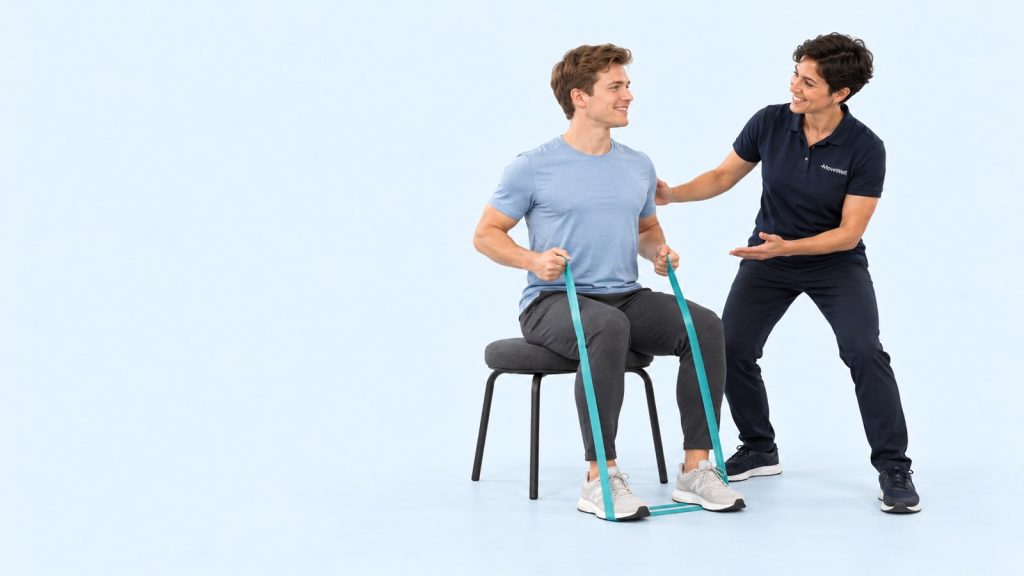
What does the treatment look like?
We follow the Dutch physiotherapy guideline for neck pain (KNGF): explanation and exercise therapy are the core. Manual techniques can support the treatment. For hard muscle knots, dry needling can help.
- Explanation and a plan. You hear why a neck becomes stiff and why moving is safe.
- Strength for the neck and shoulder blades. The deep neck muscles and the muscles between the shoulder blades carry the head. We train them lightly at first, then with an elastic band and weights in the exercise room.
- A mobile neck and upper back. A neck only turns freely when the upper back moves along.
What can you do yourself?
Keep moving. The biggest misconception is that a painful neck needs rest. A neck you hold still becomes stiffer. Even after a car accident, a collar makes recovery longer, not shorter.
Headaches that build up during the day are usually tension that piles up. Every twenty to thirty minutes, move for a minute: stand up, roll your shoulders, turn your head left and right.
The next morning rule
Pain up to 5 out of 10 during and after exercise is allowed, as long as your neck is back at its usual level the next morning. Stiffer for longer, or a headache on top? Then it was too much: take a step back and build up again.
How quickly will you notice a difference?
A neck that is stuck from posture or tension is supple again within two to six weeks for most people. With pain into the arm, expect six to twelve weeks. Tension headaches and headaches from the neck usually respond within three to six weeks. Concerned? Please contact our practice.
Who helps you in Zeist?
You have one physiotherapist, who does the examination and guides your training.
Questions about neck pain and headaches
Does physiotherapy help with neck pain?
Yes. Exercise therapy for the neck and shoulder girdle is the core of the Dutch guideline for neck pain. The effect lasts longer than with passive treatment alone.
Can I move with a stiff neck?
Yes, it is the most important treatment. Turn and nod calmly up to the edge of the pain. Avoid only movements that cause sharp pain or tingling in the arm.
How do I know which headache I have?
A tension headache feels like a band on both sides. A headache from the neck starts at the base of the skull, on one side. Migraine throbs and comes with nausea. Many people have a mix.
Does physiotherapy help with migraine?
Physiotherapy does not stop an attack. Some people get fewer and shorter attacks when the neck becomes more supple and they move regularly. It is an addition, not a replacement.
Can my headache come from my jaw?
It can. Clenching your jaw or grinding your teeth at night overloads the chewing muscles. They pass pain on to the temples and forehead. Your physiotherapist examines jaw and neck together.
Do I need an X-ray or scan?
Usually not. Your physiotherapist makes the diagnosis from your story and the examination. In most people over thirty, an X-ray shows wear that has nothing to do with the pain.
How long does treatment take?
Usually two to six weeks for a stiff neck, and six to twelve weeks with pain into the arm. Headaches from the neck usually respond within three to six weeks.
Is physiotherapy for neck pain reimbursed?
Yes, from supplementary insurance. How many sessions are covered depends on your policy. We have contracts with all Dutch health insurers and invoice them directly.
Sources for this article
This article is based on the guidelines and studies below, and on the experience of our clinicians.
- KNGF-richtlijn Nekpijn, Koninklijk Nederlands Genootschap voor Fysiotherapie (2016). View the guideline
- Exercises for mechanical neck disorders (Cochrane Review), Cochrane Database of Systematic Reviews (2015). View the review
- Neck Pain: Revision 2017, Clinical Practice Guidelines, Journal of Orthopaedic & Sports Physical Therapy (2017). View the guideline
- Global burden of neck pain (Lancet Rheumatology), The Lancet Rheumatology (2024). View the article

About the author
Jeroen Vermeer, physiotherapist at MoveWell Fysiotherapie Zeist. Physiotherapist (BIG 39920354404) at MoveWell in Zeist. Supports people with neck, back and joint complaints and recovery after surgery, with exercise therapy in the exercise room at the Panweg.
Last updated 27 October 2026.
Neck pain or headaches? Book an appointment in Zeist
You can be seen within a few days. Prefer to ask a question first? Call us on 030 695 5269 or email [email protected].