
 English
Back pain and sciatica: physiotherapy in Zeist
A painful lower back makes bending, sitting and sleeping hard, and pain into the leg makes it harder still. Four out of five people have back pain at some point. The pain is annoying, but rarely a sign of damage. Our physiotherapists in Zeist examine what your back can handle now. Then you train in our exercise room and at home with a fixed programme.
Written by Jeroen Vermeer, physiotherapist at MoveWell Fysiotherapie Zeist · Last updated 27 October 2026
In short
- A referral is not needed. If you do have one, please bring it.
- You can be seen within a few days.
- The first consultation takes thirty to fifty minutes.
- Training in our exercise room is the core of the treatment.
- MoveWell has contracts with all Dutch health insurers and invoices them directly.
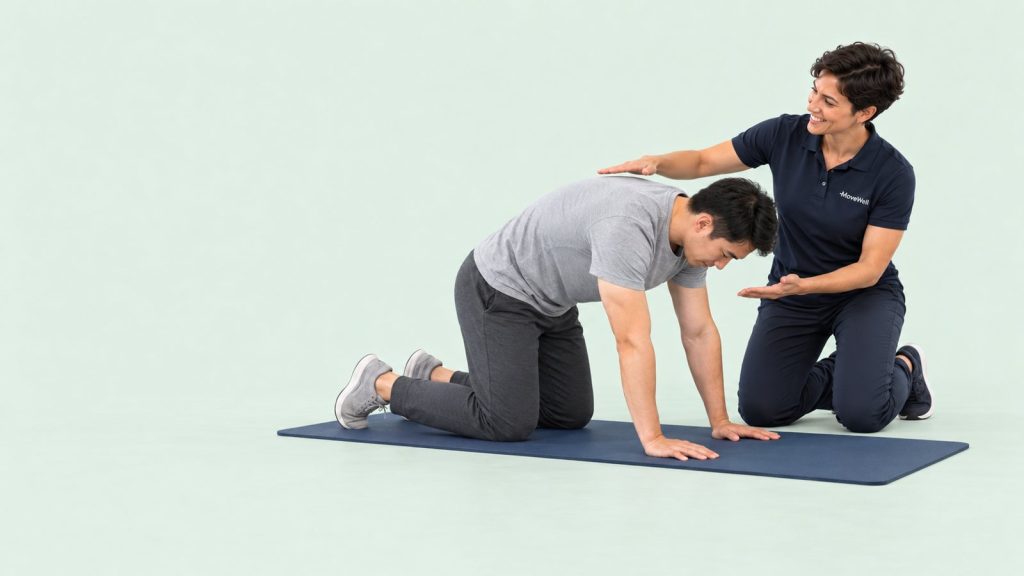
What is lower back pain?
The lower back has five lumbar vertebrae with discs in between. Small joints, ligaments and layers of muscle hold it all together. In most people with lower back pain, no damage can be found. Doctors call this non-specific lower back pain: the back had more to do than it could handle at that moment.
The body responds with muscle tension to protect the area. That tension often hurts more than the cause. When the pain runs down the leg, a nerve is involved.
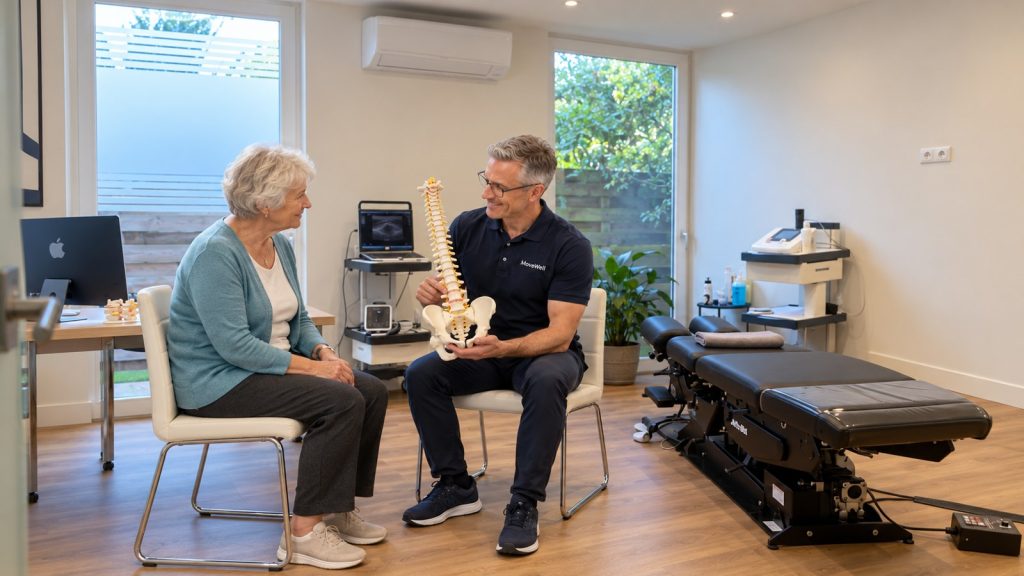
What is sciatica?
The sciatic nerve is the thickest nerve in the body. It starts low in the back, runs under the buttock muscles and splits above the back of the knee towards the calf and foot. Sciatica is pain along that nerve. You feel it in the leg, while the cause lies in the back or the buttock.
- A herniated disc in the lower back that presses on a nerve root
- An opening in the spine that has narrowed through wear
- A tight piriformis, the deep buttock muscle that lies on the sciatic nerve
How does your physiotherapist examine your back?
We start with your story: when the pain began, what makes it worse and what you no longer dare to do. Then your physiotherapist looks at how you stand, walk and move. We measure what your back can handle, such as the plank, standing up and lifting, and repeat those tests after a few weeks.
With pain into the leg, the key question is whether the irritation comes from the back or the buttock. Exercises that help one person can make the other worse. We also test strength and sensation in the foot and toes. A scan is rarely needed.

What does the treatment look like?
We follow the Dutch physiotherapy guideline for lower back pain (KNGF): explanation, staying active and graded training are the core.
- Explanation and confidence. You hear why moving is safe and how to tell a bad day from a setback.
- Core strength. Abdomen, back and buttocks get stronger, first lying down, then standing and on the machines in our exercise room.
- Room for the nerve. With sciatica from the back we look for the direction of movement that helps. From the buttock, we loosen the deep buttock muscles and the hip.
- Daily life. We practise lifting, bending and sitting, in the situations where it went wrong.
Can you keep moving with back pain?
Yes, and it helps. A painful back asks you to lie still, but it gets stiffer and weaker from that. Walk calmly, change position regularly and keep doing your daily activities. Stretching the leg is tempting, but an irritated nerve does not like being stretched.
The next morning rule
Pain up to 5 out of 10 during and after moving is allowed, as long as your back is back at its usual level the next morning. Stiffer or more painful for longer than a day? Then it was too much: take a step back and build up again.
How quickly will you notice a difference?
For most people an acute episode largely settles within two to six weeks. With sciatica, most people notice within two to four weeks that the pain in the leg reaches less far. Full recovery usually takes six to twelve weeks. Has your back been complaining for a long time? Then we work in blocks of eight to twelve weeks. Concerned? Please contact our practice.
Who helps you in Zeist?
You have one physiotherapist, who does the examination and guides your training. These pages tell you more.
Questions about back pain and sciatica
Does physiotherapy help with lower back pain?
Yes. Explanation, staying active and guided training are the first choice in the guidelines for lower back pain. It shortens an episode and lowers the chance that the pain comes back.
Should I rest when my back hurts?
No. Bed rest makes the back stiffer and recovery longer. Keep doing your daily activities, walk regularly and change position every half hour.
Is sciatica the same as a herniated disc?
No. Sciatica is pain along the sciatic nerve in the leg. A herniated disc is one possible cause. A tight deep buttock muscle can also cause it.
Should I stretch my leg with sciatica?
Preferably not. An irritated nerve becomes more sensitive when stretched. Nerve gliding is fine. Your physiotherapist shows you which movements give the nerve room without stretching it.
How long does treatment take?
An acute episode is largely over within two to six weeks for most people. Building strength takes six to twelve weeks, with one or two appointments a week and exercises at home.
Do I need a scan or X-ray?
Usually not. Wear and bulging discs also show up in people without complaints. Only with loss of strength or an unusual course do we discuss further investigation.
Why does my back pain keep coming back?
Because the cause has usually not changed: a lot of sitting, little strength or heavy work. A back that becomes stronger than it was after an episode gets a next one less often.
Is physiotherapy for back pain reimbursed?
Yes, from supplementary insurance. How many sessions are covered depends on your policy. We have contracts with all Dutch health insurers and invoice them directly.
Sources for this article
This article is based on the guidelines and studies below, and on the experience of our clinicians.
- KNGF-richtlijn Lage rugpijn en lumbosacraal radiculair syndroom, Koninklijk Nederlands Genootschap voor Fysiotherapie (2021). View the guideline
- Exercise therapy for chronic low back pain (Cochrane Review), Cochrane Database of Systematic Reviews (2021). View the review
- What low back pain is and why we need to pay attention, The Lancet (2018). View the article
- Low back pain and sciatica in over 16s: assessment and management (NG59), National Institute for Health and Care Excellence (NICE) (2020). View the guideline

About the author
Jeroen Vermeer, physiotherapist at MoveWell Fysiotherapie Zeist. Physiotherapist (BIG 39920354404) at MoveWell in Zeist. Supports people with back complaints, osteoarthritis and recovery after surgery, with exercise therapy and training in the exercise room at the Panweg.
Last updated 27 October 2026.
Back pain? Book an examination in Zeist
You can be seen within a few days. Prefer to ask a question first? Call us on 030 695 5269. Panweg 55, 3705 GB Zeist.